
Building Africa’s Physical and Intelligent Systems in the Age of AI.
Advanced economies are largely retrofitting intelligence into mature, existing physical systems.
"The West is doing AI while Africa is still building infrastructure" is a false contrast. AI itself requires enormous physical systems—electricity, grids, cooling, semiconductors, telecommunications, water, and advanced materials.
Africa must expand its physical systems while simultaneously making them intelligent.
Building power plants + smart grids
Constructing water systems + AI monitoring
Expanding manufacturing + digital control
There will not be one uniform African future. The continent will contain several futures simultaneously, blending infrastructure deficits with islands of world-class digital and industrial capability.
Rather than every country developing every industry, regional specialization is highly likely.
Global data-center investment reached roughly half a trillion dollars in 2024.
Africa currently houses only ~260 facilities continent-wide. Nigeria hosts roughly 28 data centers. The "AI frontier" is therefore deeply constrained by physical infrastructure. We must physically build the compute substrate simultaneously with software adoption.
Computing depends on reliable electricity, cooling, water and network connections.

How Africa’s largest refinery is redefining Nigeria’s oil economy. Seeking to become the biggest anywhere, it reveals both massive potential and dangerous dependency. The core shift is moving from exporting feedstocks to engineering valuable products.

Large facilities coexist with distributed networks. As seen in the Gauteng water crisis affecting major data centers, weak grids strongly encourage modular water-treatment, mini-grids, and decentralized processes alongside megaplant designs.

AI requires enormous physical systems. Major providers in South Africa represent the physical hubs needed for intelligence. By 2046, AI won't be separate; it will be the embedded control layer of plant systems, digital twins, and supply chains.

Refining, vaccine manufacturing, cultured meat, battery production, metabolic engineering, wastewater treatment, carbon capture, and AI-guided process control are different applications of the same systems framework.
Chemical engineering is not simply "chemistry at industrial scale."
It is the engineering of transformations, transport, organization, and control of matter and energy in physical, chemical, and biological systems—across molecular, cellular, equipment, manufacturing, and societal scales.
Data are not normally a raw material in the same physical sense as petroleum, biomass, cells, minerals, or gases. Data are the measurement, representation, learning, decision, or control layer.
The 9 Foundational Pillars
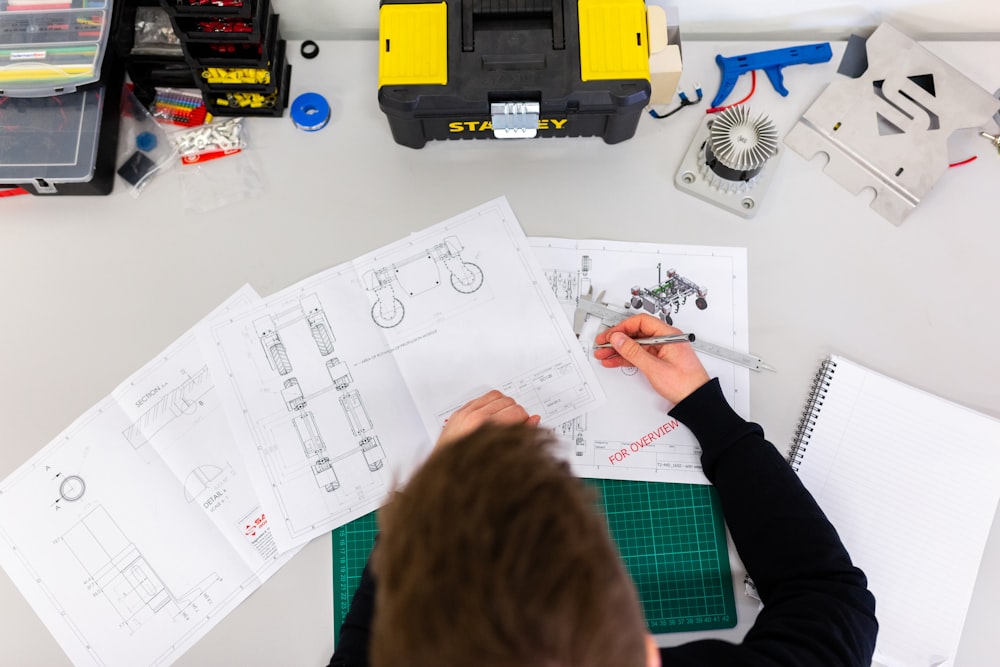
Matter and energy must be accounted for across all scales.

Determines what transformations are physically possible.

How fast reactions occur and how to make them selective.

Fundamentally concerned with how things move: connecting molecular behavior to real equipment.
Fluid mechanics, Multiphase flow, Rheology, Microfluidics, Slurries, Flow assurance.
Thermal mgmt, Exchangers, Evaporation, Cryogenics, Battery & Bioreactor cooling.
Diffusion, Convection, Membranes, Drug delivery, Tissue oxygen, Pollutant transport.

Isolating economically and at the required purity.
Integrating reactions, controls, logistics, and safety into complete systems. AIChE recognizes this covering intelligent systems, digital twins, MPC, and optimization.
Translating knowledge from molecule to material, lab batch to pilot to commercial. Mixing, heat transfer, and control change drastically with scale.
Engineering the product itself while ensuring inherent safety, risk management, and climate resilience. Safety is part of the discipline's deep identity.
Hover over each domain card to reveal the exhaustive sub-disciplines defining modern chemical engineering.


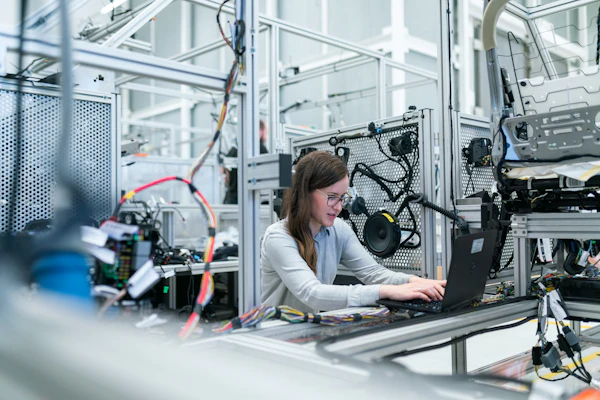


The future is not asking students to choose between being a "traditional" engineer and an "AI" engineer. The valuable professional is π-shaped.
Ability to understand and engineer matter and energy. (Thermodynamics, Transport, Reactions, Separations)
Ability to model, measure, automate, and intelligently control systems. (Data Science, Scientific ML, Sensors)
The traditional curriculum is not obsolete. It becomes more valuable because AI can generate answers without guaranteeing they obey physics, conservation laws, or safety constraints.
| Undergraduate Foundation | Africa-Facing Application | Intelligent Extension |
|---|---|---|
| Material and energy balances | Water, fertilizers, food processing, refining, waste | Automated reconciliation, digital twins, optimization |
| Thermodynamics | Hydrogen, batteries, separations, fuels, refrigeration | Property prediction, molecular screening, physics-ML |
| Fluid mechanics and transport | Pipelines, bioreactors, water networks, drug delivery | CFD surrogates, sensor-based flow monitoring |
| Reaction engineering | Petrochemicals, fermentation, pharma, catalysis | Kinetic inference, reactor optimization, autonomous labs |
| Separations | Water purification, mineral refining, pharma | Intelligent solvent selection, real-time quality prediction |
| Process control | Stable and safe plant operation | Model-predictive control, anomaly detection, RL |
| Process design & economics | Building bankable African industries | Optimization under uncertainty, lifecycle modelling |
| Process safety | Protecting people, plants and communities | Predictive risk monitoring, cyber-physical security |
The curriculum provides the governing logic. Computation and AI extend the speed, reach, and adaptiveness of that logic.
The Exhaustive Title Landscape & Career Paths
Modern digital twins require integrating mechanistic models with machine learning. Neither approach is sufficient alone.
Measurements from the process. A model grounded in physical laws. Patterns learned from data. Together, they help guide operating decisions.
Machine learning excels at finding patterns in high-dimensional data, but it can fail dangerously when pushed outside its training domain. First-principles (thermodynamics, mass balances) provide the mandatory physical guardrails for safe extrapolation.
The most complete manufacturing models use both. We apply Mechanistic Understanding where the underlying physics are known, and use Machine Learning to model complex, multivariate residuals or poorly understood kinetics.
At the peak of the pyramid, AI operates as human-like decision making based on combined physical and empirical insights—executing control optimizations much faster, consistently, and across more variables than a human operator could.

Abraham Osinuga | University of Nebraska-Lincoln
The Persistent Gap: Data-rich models can detect patterns, while mechanistic models can enforce feasibility. Yet neither alone reliably explains or redesigns complex biological behavior. My research portfolio addresses that gap across sectors and scales.
"Determine why a biological state is possible, which constraints sustain it, and how those constraints can be measured, challenged, or redesigned."
Enzymes: ML integrates sequence and substrate chemistry to estimate kinetic regimes and mutation-sensitive catalysis.
Metabolic Networks: Isotope-resolved data and perturbation modeling recover transient pathway activity and identify control points governing homeostasis.
Disease Systems: Multi-omics data are embedded within stoichiometric, thermodynamic, and enzyme-capacity constraints.
This distinguishes statistical signatures from metabolically feasible states, exposing context-specific vulnerabilities in disease networks.
Non-Model Microbes: Proteome-aware models reveal how nutrient availability and redox balance shape adaptation.
Synthetic Biology: These insights guide target selection, pathway redesign, and the development of highly robust bioproduction hosts.
Expanding this body of work through:
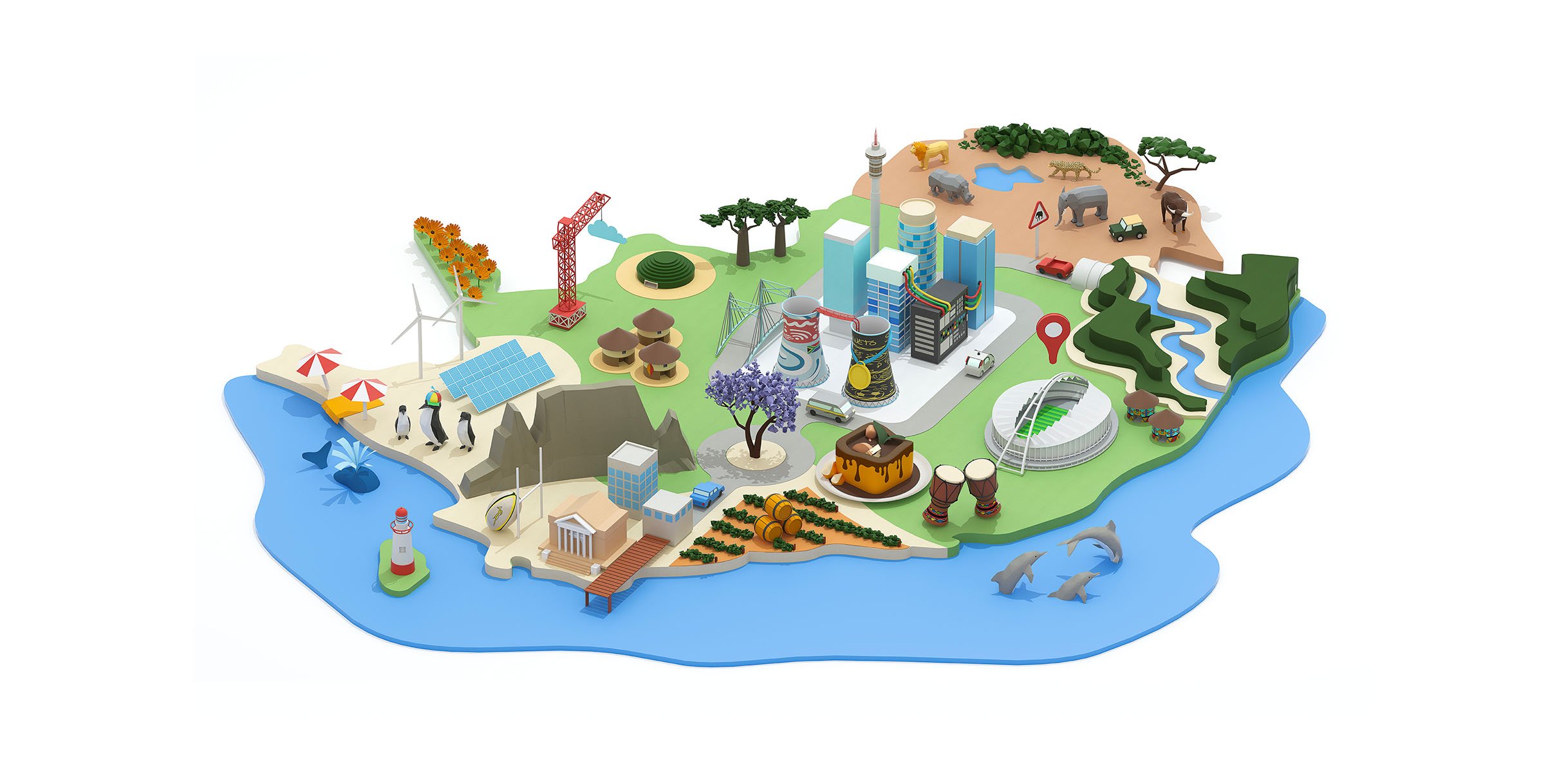
Africa could adopt AI without becoming technologically sovereign. A country may use foreign AI platforms, import complete plants, rely on external cloud infrastructure, and export unprocessed resources while still describing itself as digitally transformed.
That would produce consumption of advanced technology without ownership of productive capability. The real objective must be to possess the scientific, industrial, computational and institutional capability to build, adapt, govern, and maintain them.
By 2046, the most valuable African chemical engineer is not the one who knows the most AI tools. It is the person who can stand before a real societal problem and engineer transformations across scales.
"The West may be adding intelligence to systems it already built. Our generation must often build the system and its intelligence together. That is an opportunity to avoid obsolete infrastructure and design differently from the beginning."
Do not prepare only to operate yesterday's plants. Prepare to build Africa's physical systems, their digital representations, and the intelligence that will govern them.