When a mutation changes the enzyme, the prediction should change too.
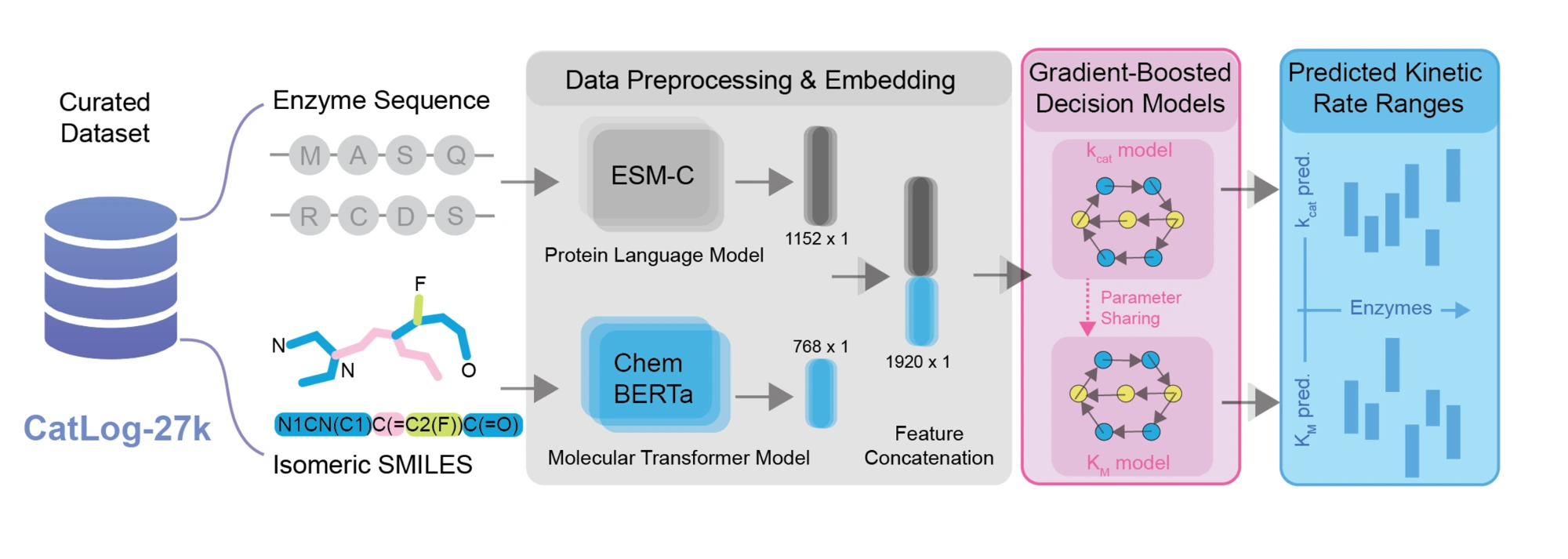
The CatRange workflow connects curated enzyme–substrate data, sequence and molecular representations, and kinetic-range prediction. Artwork supplied with this portfolio. Sajeevan, Osinuga et al., PNAS Nexus (2026).
View full figureThe Question
An enzyme can look almost identical in sequence and behave very differently after a catalytic-site mutation. How can a model reflect that difference without implying more numerical precision than the evidence supports?
My Contribution
I developed CatRange with collaborators, connecting biochemical data curation, enzyme–substrate representations, model development, evaluation, and usable inference.
- Protein representations
- Substrate chemistry
- Gradient-boosted classification
- Mutation-aware evaluation
- Research inference
What the record shows
The PNAS Nexus publication and public repository provide the research and software record. The contribution is a range-based, mutation-sensitive modeling framework—not an experimental measurement of every predicted variant.
What this does—and does not—establish
A predicted regime is not a measured kinetic constant. Neighboring-bin recovery is an evaluation criterion, not automatically a calibrated confidence interval. Assay context, sequence coverage, and the deployed bin definitions still matter.
Publication records
CatRange enables robust prediction of enzyme variant kinetic regimes
Karuna Anna Sajeevan and Abraham Osinuga et al. · First-author: Abraham Osinuga. PNAS Nexus: pgag309, 2026.
Karuna Anna Sajeevan and Abraham Osinuga share first authorship.
Robust Prediction of Enzyme Variant Kinetics with RealKcat
Karuna Anna Sajeevan and Abraham Osinuga et al. · First-author: Abraham Osinuga. bioRxiv, 2025.
Earlier preprint, version 2 (October 2025), in the CatRange research lineage.