A changing proteome. A more persistent growth-associated core.
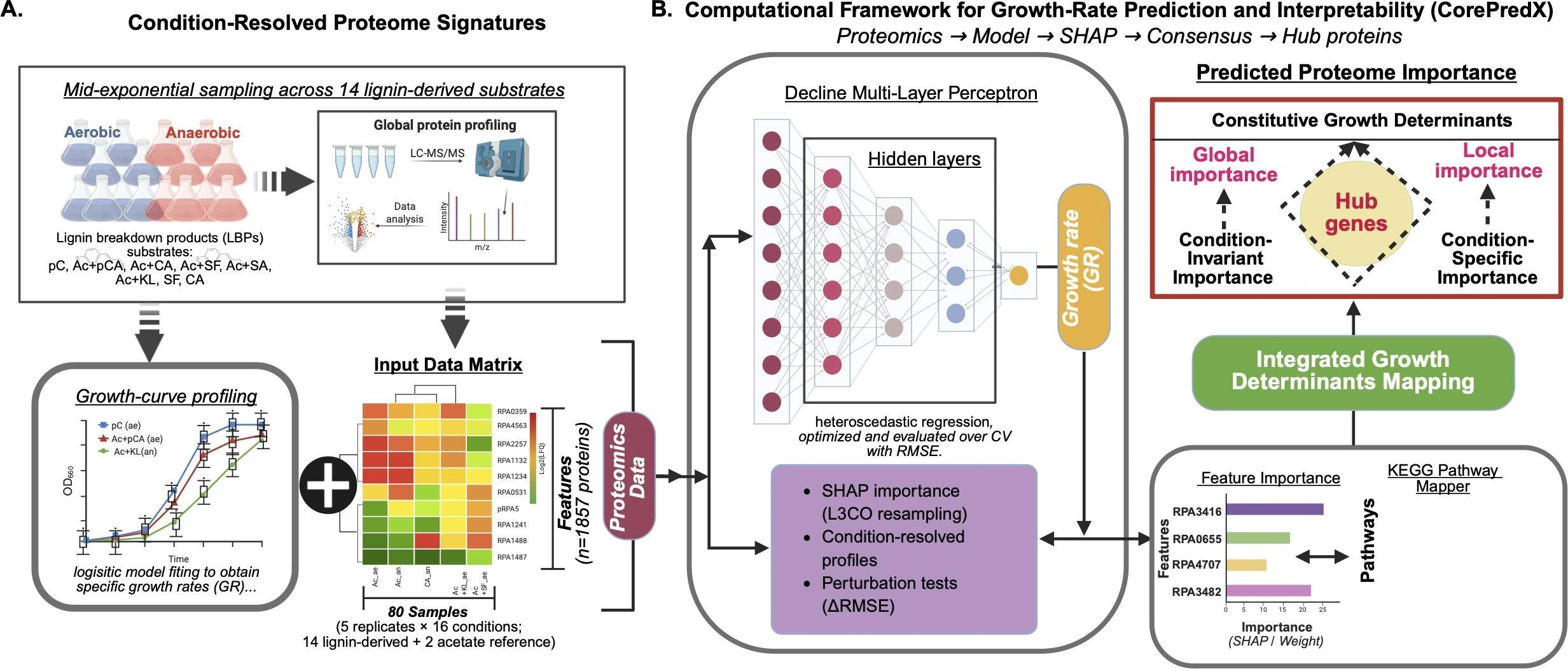
Proteome measurements feed growth-rate modeling and interpretation of shared and condition-specific growth determinants. Figure 1A–B, cropped from the published article. Osinuga, Kathol & Saha, mSystems (2026) · CC BY 4.0.
View full figureThe Question
Rhodopseudomonas palustris reorganizes its proteome across lignin-derived substrates and oxygen conditions. Which patterns remain informative about growth across those different environments?
My Contribution
I developed CorePredX to connect quantitative proteomics with growth prediction and dependence-aware interpretation. My work spans the computational question, methodology, software, analysis, validation, and scientific communication.
- Quantitative proteomics
- Neural prediction
- SHAP attribution
- Redundancy analysis
- Cross-condition interpretation
What the record shows
Published in mSystems in May 2026, the study identifies a compact hierarchy of candidate growth-associated proteins beneath broader proteome remodeling, motivating more focused biological follow-up.
What this does—and does not—establish
Predictive importance does not establish a causal regulator or a directed regulatory edge. Correlated features, the sampled environments, and independent experimental validation constrain the interpretation.
Publication record
Machine learning reveals proteome-encoded growth determinants underlying metabolic versatility of Rhodopseudomonas palustris on lignin-derived aromatics
Abraham Osinuga, Mark Kathol, and Rajib Saha. mSystems 11(6): e00383-26, 2026.